








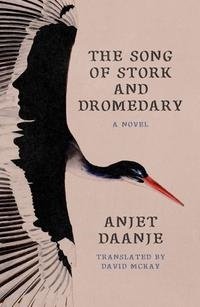

Novelist Anjet Daanje has been tipped as a serious contender for the Nobel prize in literature and, from her 2022 work The Song of Stork and Dromedary, for very good reason.
Published in Dutch as Het lied van ooievaar en dromedaris, the book is loosely based on the life of Emily Brontë, the author of Wuthering Heights. The work opens in 1847, with a villager laying out the body of Eliza May Drayden, who, like Brontë, has written a book widely derided at the time it was published but would go on to become a classic.
The opening scene is tinged with the Gothic horror of Wuthering Heights, Drayden’s eyes refuse to close for her burial.
The next 650 pages follow 11 interconnect stories that orbit around Drayden, and her sister Millicent, the fictionalised Charlotte Brontë who authored of Jane Eyre. Similar again to Wuthering Heights, all are largely set on the moors in England, though the final story takes the reader to the Daanje’s hometown of Groningen.
Rather than a traditional narrative, the book is written like an expansive biography, incorporating news articles, excerpts from diaries, letters, citations from fictional biographies and even parts of Drayden’s novel.
Each of the tales could be novellas in their own right, vivid and sometimes nail-biting, sending the reader off on tangents such as the mistreatment of two half-German sisters during the Second World War, or a pair of French half-sisters whose shared father creates a wedge between them.
The nature of sisterhood and the relationship between various female characters is one of the central themes of The Song of Stork and Dromedary. The work also reflects on the status of women at different times across the novel’s 200-year span.
Death is another important theme. Drayden’s death, with which the book opens, is an event that brings characters together but also tears them apart.
Anjet Daanje published eight novels before The Remembered Soldier (De herinnerde soldaat) became a hit in 2019. It was longlisted for the Libris Literature Prize, took home the F. Bordewijk Prize and the English-translation, which was published in 2025, was longlisted for International Booker Prize and included on The New York Times Book Review’s 100 Notable Books of 2025.
The Song of Stork and Dromedary took home both the Boekenbon Literature Prize and the Libris Literature Prize, the first book to ever net both awards. It was named the Best Book of the Century by the NRC newspaper. The English translation was published this year.
In 2023, Daanje was awarded the Constantijn Huygens Prize for her oeuvre.
The book was translated by David McKay, who also translated War and Turpentine by Stefan Hertmans and Multatuli’s Max Havelaar. He renders the complicated work thoughtfully, retaining Daanje’s character.
The Song of Stork and Dromedary is compelling and brilliant, and the author is worthy of the highest honour in literature.
The Nobel prize for literature winner will be announced on Thursday by the 18 members of the Swedish Academy.
You can get your copy at the American Book Center.