









You can’t have failed to notice that Dutch cycle paths are no longer the preserve of old-fashioned cyclists. E-bikes, fatbikes, scooters, snorfietsen, speed pedelecs, disabled vehicles – a seemingly never-ending stream of other road users have moved in. But what exactly are the rules and regulations?
Lesson 64: what is allowed on the cycle path?
Fatbike
The fatbike, with its characteristic thick tyres and frequently thick riders, has become wildly popular. It’s not surprising because at the moment, riders do not need a helmet, driving licence, or third-party liability insurance. The fatbike is officially an e-bike, and therefore there is no age limit, but measures are afoot to make helmet-wearing compulsory for riders up to the age of 18.
Fatbikes are allowed to travel at up to 25 kph. However, many are doctored to go faster – as you will notice when you see them whizzing past cars that keep to the 30 kph limit, mandatory for cars in some Dutch cities.
Electric bike
The electric non-fat bike, so to speak, is literally overtaking the person-powered bike, and that is partly due to its popularity among older riders – who are also well represented in the annual traffic death toll. The same rules of the road as apply to fatbikes apply to ordinary e-bikes – none. You will, however, see more and more elderly riders with a helmet.
Electric cargo bike
The cargo bike, or moedermobiel, deserves a separate mention because of the riders’ mistaken opinion that everyone has to make way for this space-hogging vehicle because it carries cute little toddlers. A good place to spot cargo bikes is outside primary schools at 3pm, when they cause a veritable jam of their own.
Speed pedelec
Speed pedelecs are electric bikes as well, but unlike normal electric bikes, they can legally reach speeds of up to 45 kph. This makes them motorcycles in the eyes of the law, with the rules that then apply, such as mandatory helmet-wearing, a driving licence and insurance. Speed pedelecs can travel on cycle paths, but only at a maximum of 25 kph.
Snorfiets, or moped
No pedalling is needed for this motorised bike or moped, which has a maximum speed limit of 25 kph and is allowed on cycle paths. Although snorfietsen have the same speed limit as electric bikes, they are technically considered to be motorcycles, and riders need a helmet, a driving licence and insurance.
The introduction of helmets for all types of mopeds several years ago led to the downfall of the snorfiets – after all, if you need a helmet, why not drive a proper motorbike – or a fatbike?
Scootmobiel
The motorised wheelchair or scootmobiel is possibly the most dangerous vehicle on the cycle path. According to statistics agency CBS, the traffic death rate among mobility scooter riders is over six times that of motorbike riders and over 20 times that of cyclists.
Users don’t need to pass any tests or learn the rules of the road, and they can go pretty much wherever they like – shopping centre, pavement, cycle path, ordinary road – just not the motorway.
The Canta
The Canta looks like a brommobiel – a small electric vehicle with four wheels – but because it is considered a mobility aid for people with a disability, it is treated in the same way as a scootmobiel.
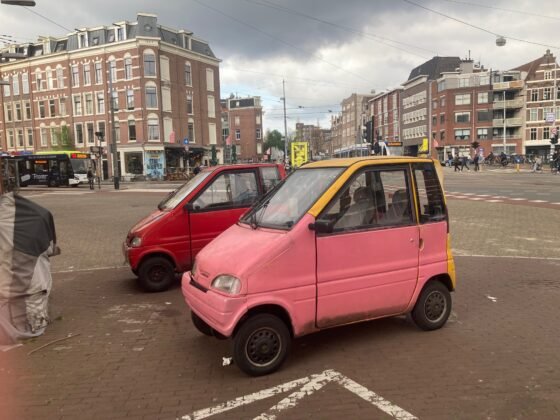
The Canta is not supposed to go faster than 30 kph on the cycle path and 45 kph on the road, but is allowed to mount the pavement and annoy pedestrians at 6 kph. It can also park anywhere and does not need a number plate.
The minimum age is 16, and you’ll need to take out insurance, but you don’t need a driving licence. The Canta became popular with youngsters who could not be bothered to cycle and has since spawned a surge in far hipper micro cars.
Micro cars
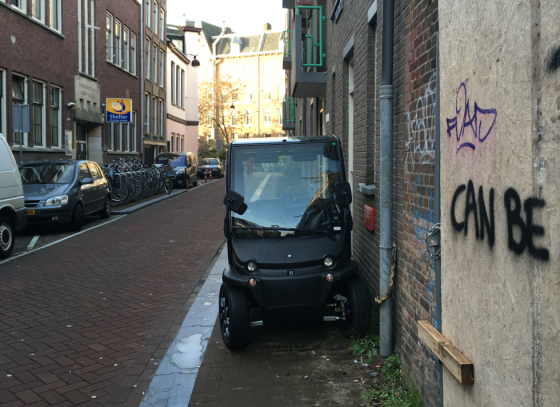
The Birò and its ilk are small, fashionable and, according to many, extremely annoying electric vehicles which are banned from cycle paths but whose drivers use them anyway – particularly as a sneaky escape when faced with a traffic jam.
Popular with estate agents and PR people, micro cars have a maximum speed of 45 kph. If you want one, you will need a brommobiel driving licence and must be 16 or over.
Electric scooter
The step, or scooter, used to be a children’s plaything, but since the invention of the electric version, they have been taking over cities throughout Europe. Steps which have been officially approved have been allowed on Dutch cycle paths since July 1 this year. In Dutch terminology they are known as “light electric vehicles”.
The step has a maximum speed of 25 kph, and riders have to be 16 or over. You will need third-party liability insurance, and the base must have a number plate which is clearly visible.
The e-step is predicted to rival the fatbike in popularity and ability to provoke cycle-path rage – as long as helmets are not compulsory.